Updated: August 2026
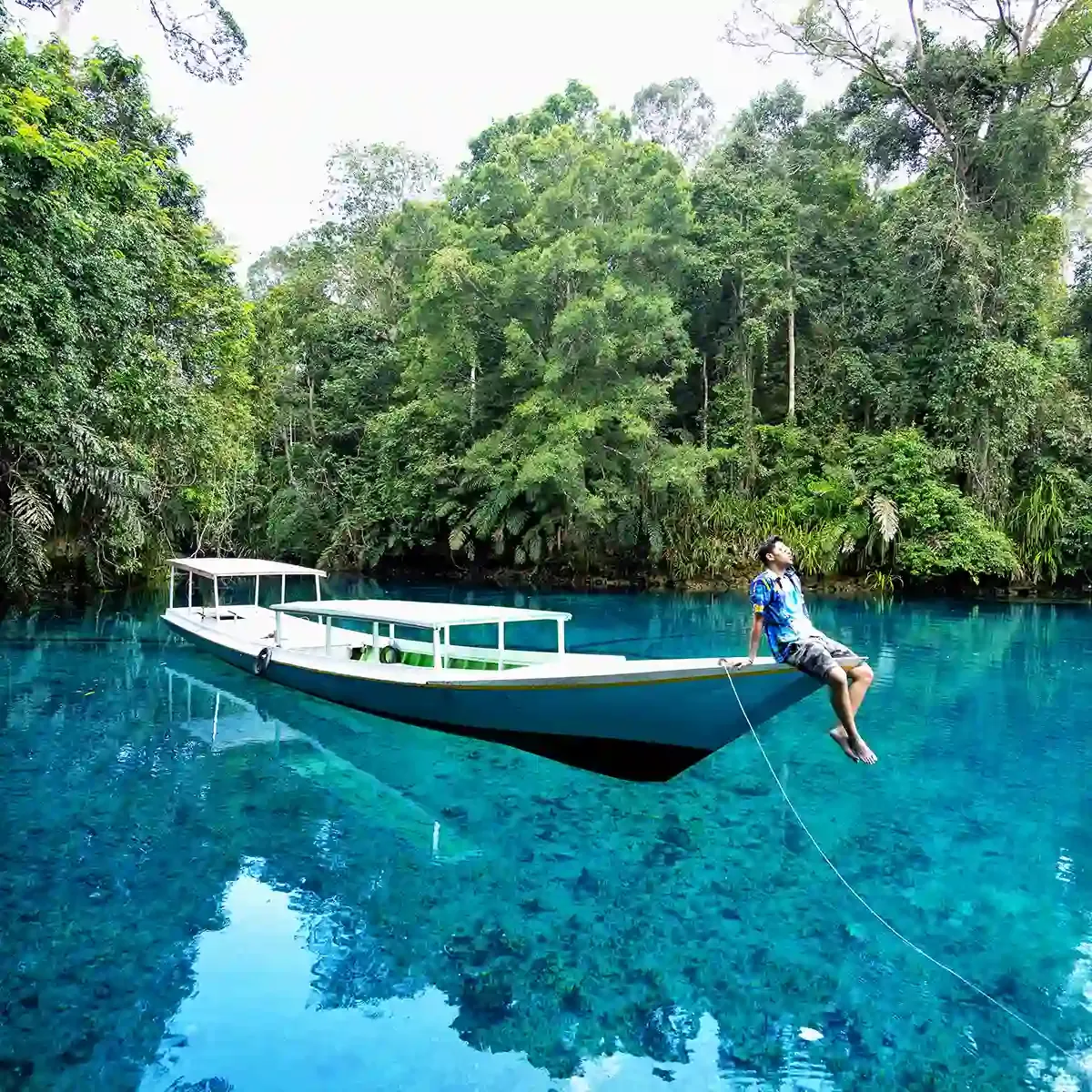
Labuan Cermin is a stratified coastal lake in Biduk-Biduk, Berau Regency, East Kalimantan, where a layer of fresh water floats on top of denser salt water and the visibility is so complete that wooden boats appear to hover in mid-air. It is the most photographed freshwater site in the Berau region and is almost always visited as a mainland extension of a Derawan Islands trip, on the same southbound coastal road that reaches the Talisayan whale sharks.
This page covers what the lake actually is, how to reach it from Kalimarau Airport and from the islands, how long to spend there, the months that work best, and how a Labuan Cermin tour fits into a wider Derawan Archipelago destinations itinerary run by Indonesia Juara, part of Juara Holding Group since 2015. If you already know you want the lake, the combined Derawan Island tour is where the routing is built.
Labuan Cermin is a two-layer lake, not a normal freshwater lake
The local name translates roughly as “mirror lake”, and the mirror effect is not a marketing phrase — it is a physical consequence of how the water column is arranged. A layer of fresh water, fed by rainfall and forest runoff, sits on top of a heavier salt-water layer that connects to the sea. The two layers do not mix. Instead they meet at a sharp boundary a couple of metres below the surface, and because there is almost no suspended sediment in either layer, light passes through with very little scattering.
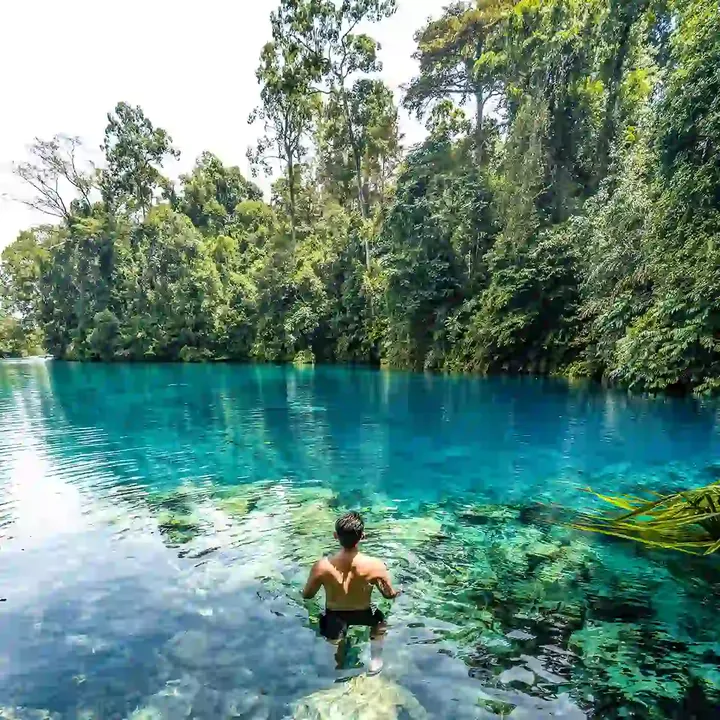
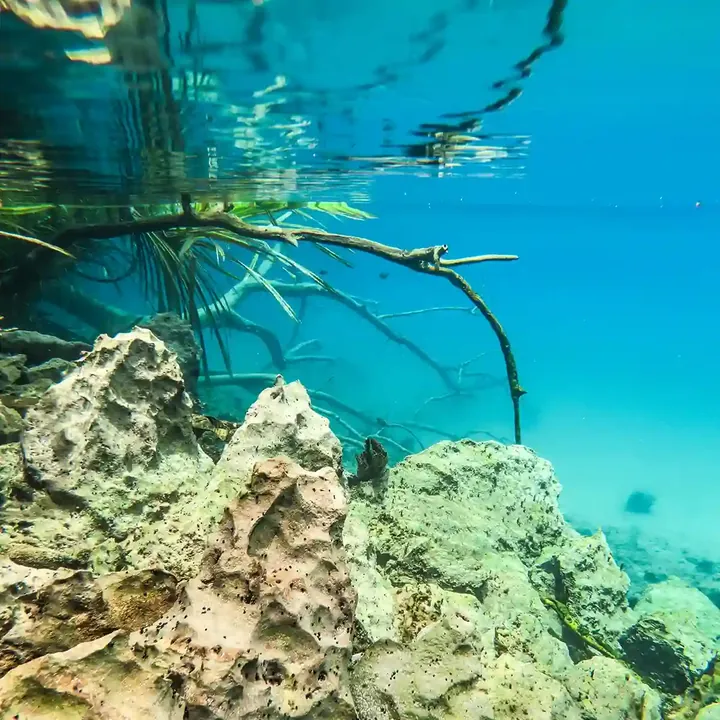
What this means in practice for a visitor: when you float on the surface, you can look straight down and see the sand, the sunken timber and the fish below with almost no haze. When you dive down through the boundary, the water changes temperature and taste within the space of one body-length, and looking back up you can see the underside of the boats above you as a clean silhouette. Snorkellers who have already been to Kakaban Island jellyfish lake often describe Labuan Cermin as the opposite experience — Kakaban is a living aquarium you swim through slowly, Labuan Cermin is an optical event you swim inside.
The lake sits in a narrow basin ringed by limestone and forest. It is small and shallow enough that a short wooden boat ride crosses it in a few minutes, and there is no scuba diving here — this is a swimming, freediving and snorkelling site only.
How to get to Labuan Cermin from Berau, Talisayan and the Derawan Islands
Labuan Cermin is on the mainland, not on an island, so it is reached by road and then by a short boat transfer across to the lake mouth. Every practical route starts from Kalimarau Airport (BEJ) in Berau, which is the meeting point Indonesia Juara uses for all Derawan private trips. There is no direct sea route from Derawan Island that avoids the mainland road.
| Leg | Approximate distance | Typical travel time | Notes |
|---|---|---|---|
| Kalimarau Airport (BEJ) to Biduk-Biduk village | Around 250 km by road | Roughly 6 hours by private vehicle | Single long coastal drive; usually done as a dedicated travel day |
| Talisayan to Biduk-Biduk | Around 90 km by road | Roughly 2 hours | The efficient pairing — whale sharks at dawn, mirror lake the same day |
| Biduk-Biduk jetty to the lake | Under 1 km on water | About 5 minutes by wooden boat | Small local boats; life jackets provided at the jetty |
| Derawan Island back to the mainland | Varies by pier used | Speedboat crossing, then road | Requires returning to the mainland first — plan it as a separate day |
Because of that six-hour drive, Labuan Cermin is almost never a half-day add-on tacked onto an island day. It works when it is scheduled deliberately: either at the very start of the trip on the way down from the airport, or on the way back before the flight out. Full routing options, including which gateway airport suits your connection, are set out on how to get to the Derawan Islands and on the Derawan via Berau (Kalimarau) route page.
What you actually do at Labuan Cermin
The activity list is short and physical rather than sightseeing-heavy, which is why most visitors budget two to three hours on the water rather than a full day.
- Swim through the halocline. The single reason people come. Duck-dive two to three metres, feel the temperature change, and look back up at the boats from below.

- Snorkel the shallow edges. Freshwater fish gather over the pale sand and around submerged branches near the shoreline.
- Freedive the deeper basin. Experienced freedivers use the clarity for weightless descents; there is no dive operator, no tanks and no guide-led scuba here.
- Jump from the wooden platform. A jumping deck sits over the deep section — the standard photograph of the lake.
- Photograph from the boat. Mid-morning light with the sun high enough to punch through the surface is when the “floating boat” effect is strongest.
Sunscreen, insect repellent and soap are not appropriate in the lake — the stratified water column is fragile and the local community manages access carefully. Rinse before entering, and treat the site the same way you would treat the jellyfish lake on Kakaban.
The best time to visit Labuan Cermin is April to November, mid-morning
Indonesia Juara operates Derawan private trips from April to November, and that window applies to Labuan Cermin as well. Two separate factors matter here.
Season. Heavy rain does two things: it makes the long coastal road slower and less comfortable, and it pushes forest runoff into the upper freshwater layer, which reduces clarity for a day or two afterwards. The drier months inside the April to November window give the most reliable mirror effect. The same months are also the strongest period for manta ray snorkelling at Sangalaki and for calm island crossings, which is why the whole archipelago runs on one season.
Time of day. The lake reads best when the sun is high enough to drive light straight down through the surface — broadly mid-morning to early afternoon. Very early morning gives flat water but weaker light penetration; late afternoon gives warm light but longer shadows from the surrounding ridge. If you have driven down from Talisayan after a dawn whale shark session, you will arrive naturally inside the good window.
How long to spend, and where Labuan Cermin fits in a Derawan itinerary
Two to three hours at the lake is enough for almost everyone. The planning question is not how long to stay at Labuan Cermin — it is how to absorb the road day without losing island time. Here is how it fits into the two package lengths Indonesia Juara runs.
| Trip length | Realistic coverage | Where Labuan Cermin sits | Trade-off |
|---|---|---|---|
| 3D2N | Islands plus one mainland highlight | Paired with Talisayan on a single southbound day | Tight; one island group gets less water time |
| 4D3N | Islands plus both mainland highlights, unhurried | Own day, usually arrival day or departure day | The comfortable choice for photographers and families |
The nine destinations Indonesia Juara covers across these itineraries are Talisayan, Maratua, Kakaban, Sangalaki, Goa Halo Tabung, Manta Point, Pasir Gusung Sanggalau, Laguna Kehe Daing and Labuan Cermin. If Labuan Cermin is your priority, say so at enquiry stage — the routing is built around whichever sites you rank first. A combined Derawan island hopping tour that includes both the lake and the whale sharks needs the 4D3N frame to breathe, while Maratua Island stays the natural base for anyone who wants more time in the water and less time in a vehicle.
What a Derawan and Labuan Cermin tour costs
Indonesia Juara runs Labuan Cermin as part of a Private Trip Derawan 3D2N or 4D3N, not as a standalone excursion, with a minimum of two participants and a meeting point at Kalimarau Airport (BEJ) in Berau. Rates are per person and depend on two things: how many people are in your group, and whether you take the standard or premium accommodation tier.
| Group size | Standard tier | Premium tier |
|---|---|---|
| 2 people | from USD 580 per person | from USD 672 per person |
| 3 people | from USD 442 per person | from USD 506 per person |
| 4 people | from USD 391 per person | from USD 437 per person |
| 5 people | from USD 331 per person | from USD 368 per person |
| 6 people | from USD 359 per person | from USD 391 per person |
| 7 people | from USD 340 per person | from USD 368 per person |
| 8 people | from USD 322 per person | from USD 345 per person |
| 9 people | from USD 281 per person | from USD 304 per person |
| 10 people | from USD 285 per person | from USD 304 per person |
Two honest notes on that table. First, the per-person rate does not fall in a perfectly straight line as the group grows — at certain group sizes an additional vehicle, boat or room is required, and the cost per head steps back up before falling again. Second, these are starting rates in USD converted from the underlying IDR pricing, so the exact figure on your written quotation depends on the date, the accommodation actually confirmed and the currency rate at the time of booking. Full package structures are listed under Derawan tour packages and on the Derawan trip page.
What the rate covers, and what to confirm in writing
The published per-person rate is built around a private trip that begins and ends at Kalimarau Airport, with ground and boat transport between the destinations on your itinerary and accommodation at the tier you choose. Accommodation is drawn from the properties Indonesia Juara works with in the region: Reza Derawan Resort, Alfit VIP Borneo Cottage, Sienna Resort, Maratua Paradise Resort, Arasatu Villa, Pratasaba Resort and Seheku Paradise. Which property you get depends on your tier, your route and availability on your dates — comparisons are on where to stay in the Derawan Islands.
Items you should ask to see itemised on the quotation before you pay anything, rather than assume:
- Domestic flights to and from Kalimarau Airport (BEJ) — these are booked by most travellers separately
- Any site entrance, jetty or conservation contributions collected locally
- Personal diving equipment and any scuba activity, since Labuan Cermin itself is snorkel-and-swim only
- Travel insurance
- Meals outside the ones written into your itinerary
- Any extra night before or after the trip window
Ask for the written breakdown at sales@indonesiajuara.asia. A trip that includes a six-hour road leg is one where the itinerary should be agreed on paper first — this is not a destination where improvising on the day works well.
Labuan Cermin pairs best with Talisayan, not with the outer islands
If you are choosing which mainland day to buy, the strongest combination is Labuan Cermin plus the whale sharks. Both sit on the same southern coastal road, the whale shark encounter happens at dawn and the lake reads best mid-morning, so a single day covers both without either feeling rushed. Details on the encounter itself, including how the fishing platforms work and what the season looks like, are on the Talisayan whale shark tour page.
The pairing that does not work well is trying to squeeze Labuan Cermin between two island days. The outer islands — Maratua, Kakaban, Sangalaki — are a boat-based cluster, and inserting a mainland road day into the middle of them costs you a full day of water time for no logistical gain. Plan the mainland leg at one end of the trip and keep the island days consecutive. Route and cost planning for the whole archipelago is collected under plan your Derawan trip.
Frequently Asked Questions
Where exactly is Labuan Cermin?
Labuan Cermin is located in Biduk-Biduk, in the southern part of Berau Regency, East Kalimantan, on the Indonesian side of Borneo. It is a mainland site, not one of the Derawan islands, and it lies roughly 250 km by road south of Kalimarau Airport in Berau — around six hours of driving. Visitors reach the water itself by a short wooden boat transfer of about five minutes from the village jetty.
Why is Labuan Cermin called the mirror lake?
The name refers to the lake’s exceptional clarity, which comes from a stratified water column where fresh water sits on top of salt water without mixing. Because there is almost no suspended sediment in either layer, light passes down with very little scattering, so boats on the surface appear to float in mid-air when viewed from below or from the side. Swimmers can feel the temperature and salinity change a couple of metres down.
Can you swim and snorkel in Labuan Cermin?
Yes — swimming, snorkelling and freediving are the entire point of visiting Labuan Cermin, and there is no scuba diving at the site. Life jackets are available at the jetty and a wooden platform over the deep section is used for jumping. Sunscreen, repellent and soap should be rinsed off before entering, because the stratified layers are fragile and the site is managed by the local community.
How do I combine a Derawan and Labuan Cermin tour?
The standard combination is a Private Trip Derawan of 3D2N or 4D3N that begins at Kalimarau Airport (BEJ) and treats the mainland as one dedicated day. Labuan Cermin is paired with the Talisayan whale sharks on the same southbound road, either on the arrival day or the departure day, with the island days kept consecutive. The 4D3N version is the comfortable option; 3D2N works but leaves less water time on the outer islands.
What is the best time of year to visit Labuan Cermin?
Indonesia Juara operates Derawan private trips from April to November, and that is the window that suits Labuan Cermin too. Drier conditions mean less forest runoff into the upper freshwater layer, so clarity is more reliable, and the long coastal road is faster and more comfortable. Within the day, mid-morning to early afternoon gives the strongest light penetration and therefore the clearest version of the mirror effect.
How much does a trip including Labuan Cermin cost?
Rates start from USD 580 per person for two travellers on the standard tier and drop as the group grows, reaching from USD 281 per person at nine travellers, with premium-tier accommodation priced above each of those figures. The rate depends on group size and accommodation tier, and it does not fall in a straight line, because some group sizes require an extra vehicle, boat or room. Request an itemised written quotation at sales@indonesiajuara.asia.