Derawan Snorkeling Spots

Derawan Snorkeling Spots
Derawan Snorkeling Spots — Derawan Archipelago, Berau, East Kalimantan

Updated: August 2026

The best Derawan snorkeling spots are the nine stops on the classic archipelago circuit: the turtle shallows off Derawan Island, the stingless jellyfish lake on Kakaban, the manta feeding grounds at Sangalaki and Manta Point, the cave pool and hidden lagoon on Maratua, the sandbar at Pasir Gusung Sanggalau, the whale shark platforms at Talisayan, and the two-layer mirror lake at Labuan Cermin. All of them are snorkeling sites, not dive-only sites — you need a mask, fins and the ability to float, not a certification.

This page maps every spot in the order a boat actually visits them, tells you what lives at each one, when the water is workable, how many days you need, and what a guided trip costs per person. Derawan Island is operated as a trip destination by Indonesia Juara, part of Juara Holding Group since 2015, and the snorkeling circuit below is the same one our guides run from Kalimarau Airport in Berau. For the full list of things to do in the archipelago, see the Derawan activities category.

The Derawan archipelago has nine signature snorkeling spots across four islands and two lakes

The best snorkeling in Derawan is unusual because the highlights are not variations on the same reef. One stop is a landlocked jellyfish lake, one is a plankton-rich manta channel, one is a freshwater-over-saltwater lake on the mainland, and one is a dawn appointment with whale sharks under fishing platforms. That variety is the reason a three-day circuit rarely feels repetitive. The table below is the working shortlist.

SpotWhere it isWhat you snorkel withBest for
Derawan house reefDerawan IslandGreen turtles, seagrass shallows, reef fishFirst-timers, families, unlimited free time
Kakaban jellyfish lakeKakaban IslandStingless jellyfish in a landlocked lakeThe signature Derawan photograph
Laguna Kehe DaingKakaban IslandSheltered lagoon reached through a rock cleftCalm water, non-swimmers who stay shallow
SangalakiSangalaki IslandManta rays, green turtle nesting beachWildlife, big-animal encounters
Manta PointOff SangalakiFeeding manta rays in open waterConfident snorkelers, drift conditions
Goa Halo TabungMaratua IslandEnclosed cave poolSomething completely different
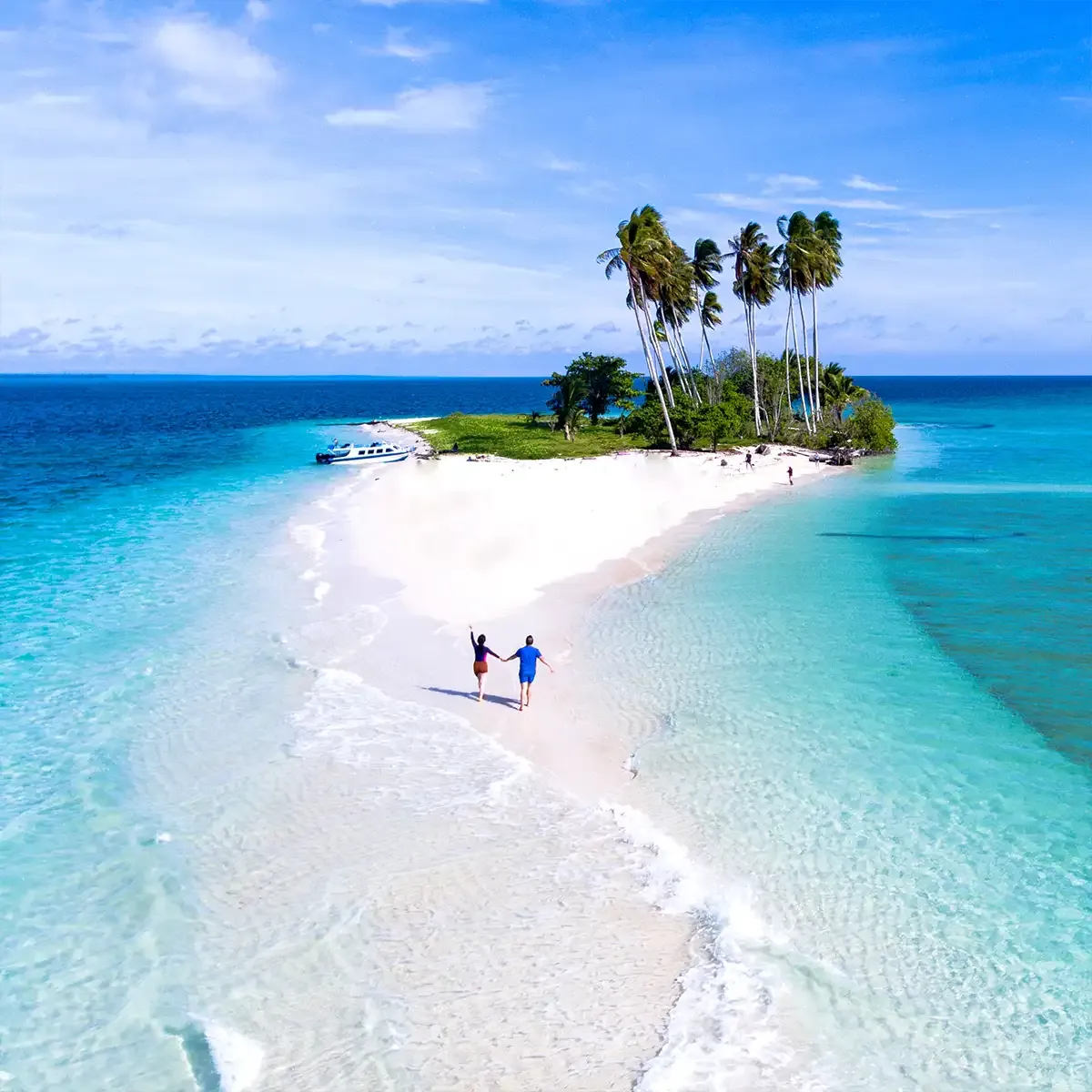
Pasir Gusung SanggalauBetween the islandsSandbar that surfaces at low tidePhotos, shallow reef edges
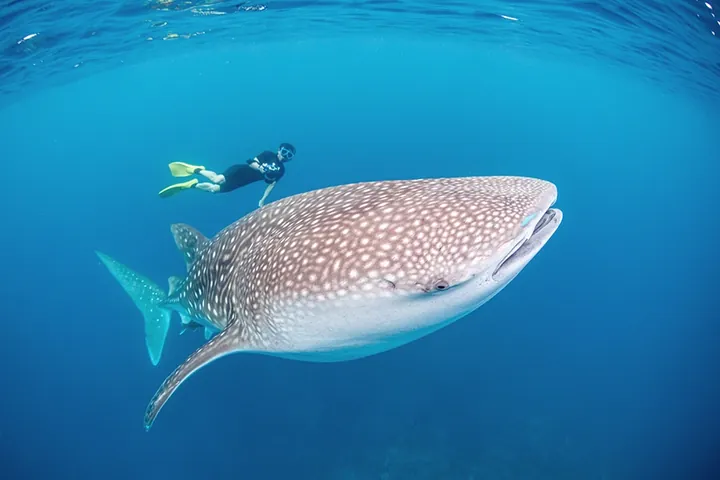
TalisayanMainland coast, BerauWhale sharks around fishing platformsDawn wildlife, once-in-a-trip moment
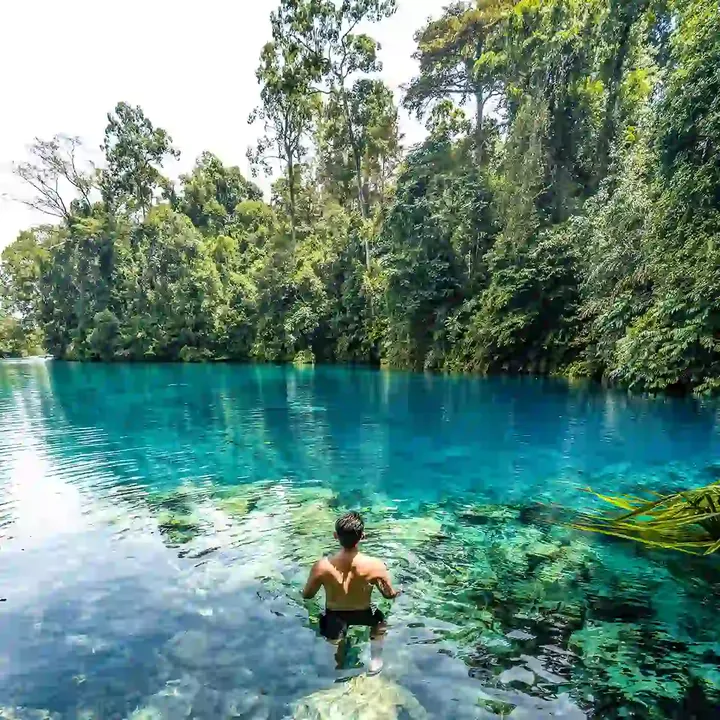
Labuan CerminBiduk-Biduk, mainlandFreshwater layer sitting over saltwaterClear-water swimming, no reef

Derawan Island itself is the easiest place to snorkel with green turtles

Derawan Island snorkeling is the base case of the archipelago, and this is the only spot on the list you can reach without booking a boat. The shallows and seagrass beds around the village and its jetties are grazing ground for green turtles, which is why most visitors get their first turtle sighting within an hour of arriving rather than on a dedicated excursion. Water here is waist-to-chest deep in places, so it suits nervous swimmers, children and anyone who wants to test their mask before the longer boat days.

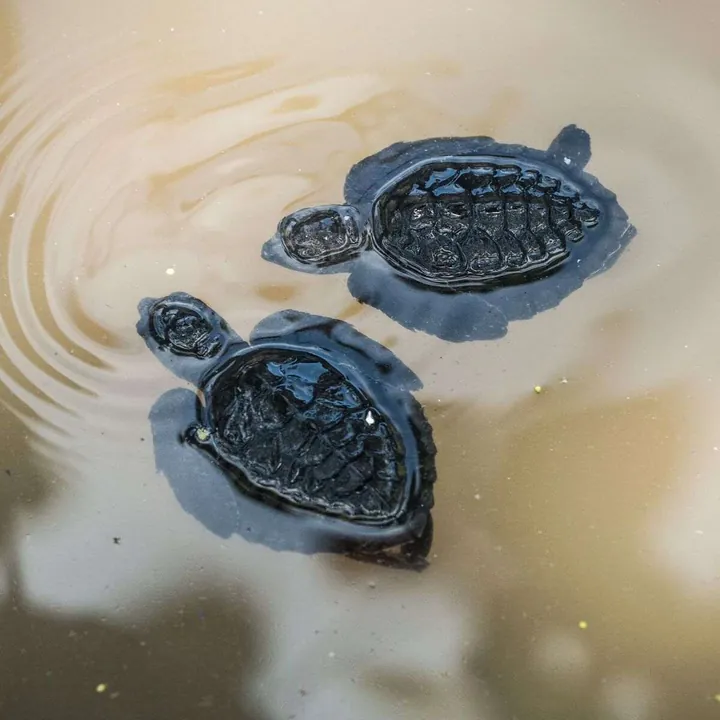
Because the reef is on your doorstep, Derawan is where flexible time goes: an early swim before breakfast, a second one at golden hour, and a night walk on the sand during nesting periods. If turtles are the reason you are coming, read the dedicated guide to green turtle nesting in Derawan before you book, because nesting behaviour and hatchling releases follow their own rhythm and are worth timing your stay around.

Kakaban is the only stop where you swim in a lake instead of the sea

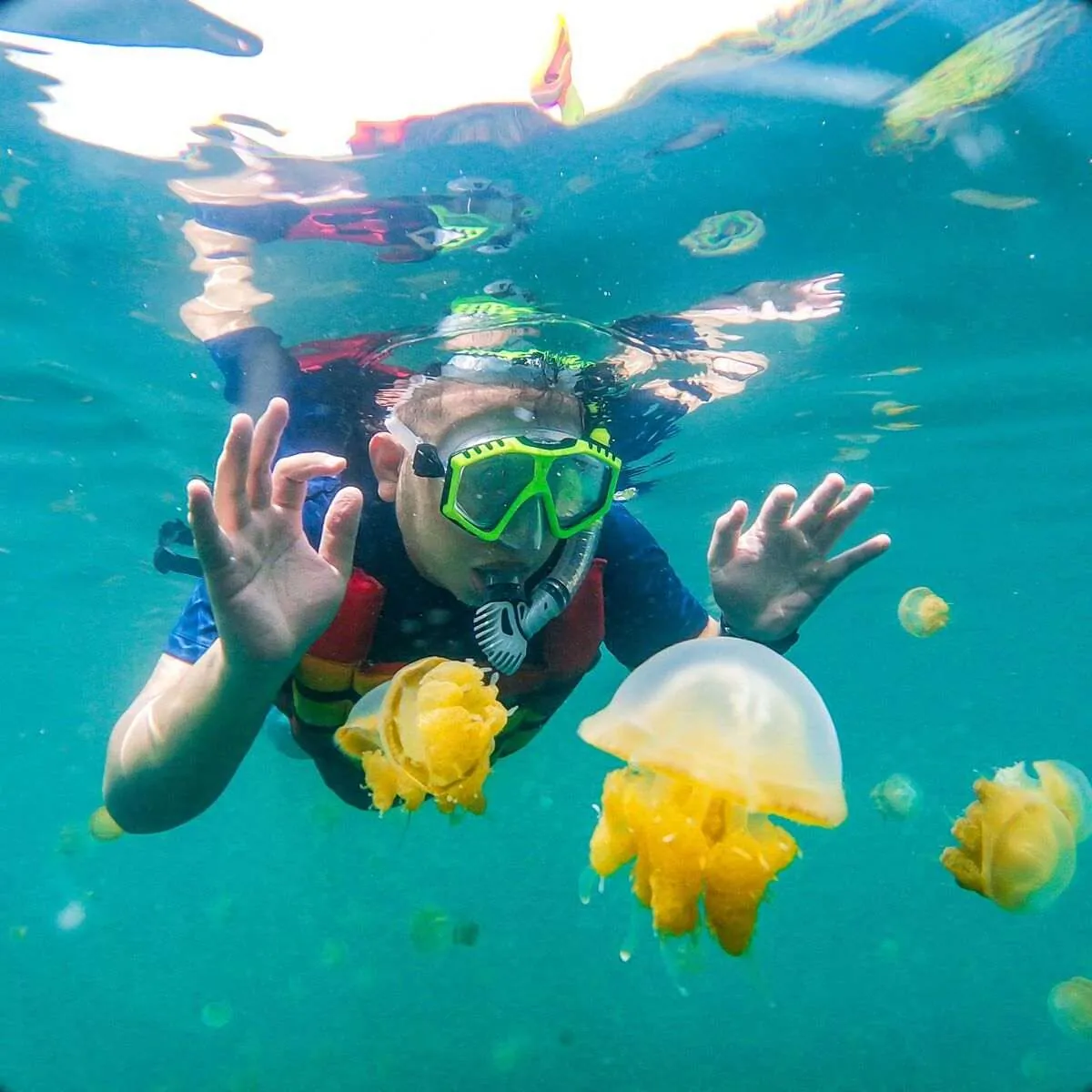
Kakaban’s jellyfish lake is the single most photographed snorkeling site in the archipelago and one of a very small number of stingless jellyfish lakes anywhere in the world. The lake sits inside the island, sealed off from the ocean long enough that its jellyfish lost the need for a working sting, so you can float among them safely. The rule everywhere on Kakaban is the same: no fins in the lake, no sunscreen residue in the water, no lifting or handling the animals. Fins damage jellyfish and stir the lake bed.

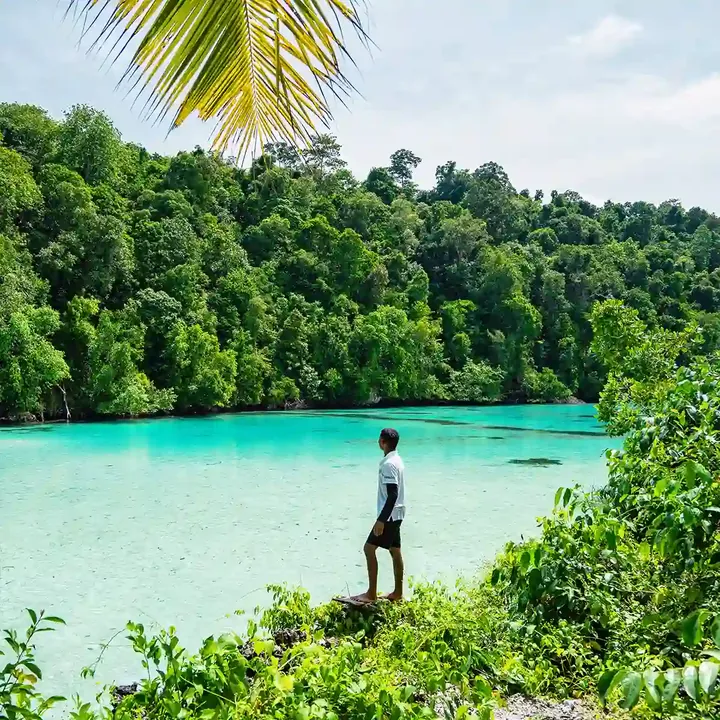
The second Kakaban stop is Laguna Kehe Daing, a lagoon reached by squeezing through a narrow gap in the rock. It is sheltered, shallow at the edges and completely different in character from the exposed reef stops. Both are covered in depth on the Kakaban Island and jellyfish lake guide, including the walk in from the jetty and the etiquette that keeps the lake healthy.

Sangalaki and Manta Point are where snorkelers meet manta rays

Sangalaki is the wildlife stop. Manta rays gather in the plankton-rich water around the island to feed, and because they feed near the surface, snorkelers see them as well as divers do — this is the rare big-animal encounter that does not require a dive certificate. Sangalaki’s beaches are also a green turtle nesting site, which makes it the highest-density wildlife stop of the whole circuit.

Manta Point, just off the island, is the more exposed of the two. It is open water with current, so it rewards confident snorkelers who can hold position and follow a guide’s line. If you are not a strong swimmer, stay on the sheltered Sangalaki side — you will still see animals. Full detail on the island sits on the Sangalaki Island page, and the technique, positioning and no-touch rules for these encounters are covered in the manta ray snorkelling guide.

Maratua adds a cave pool, drop-off reefs and the archipelago’s dive country

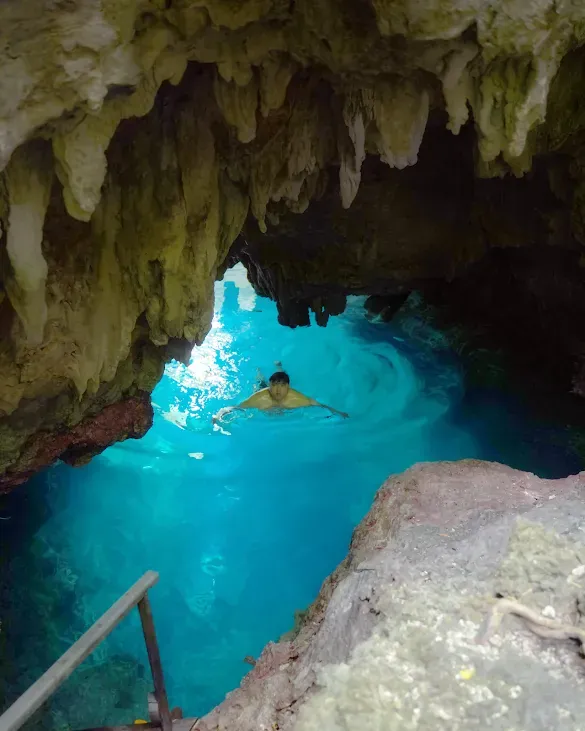
Maratua is the largest island in the group and the one that feels most like a destination in its own right rather than a stop. Goa Halo Tabung is its signature snorkeling curiosity: an enclosed cave pool inland from the coast, still and sheltered, with none of the swell of the outer reefs. Around the island’s rim, the shallow reef flats drop away into the channel that has made Maratua famous with divers.
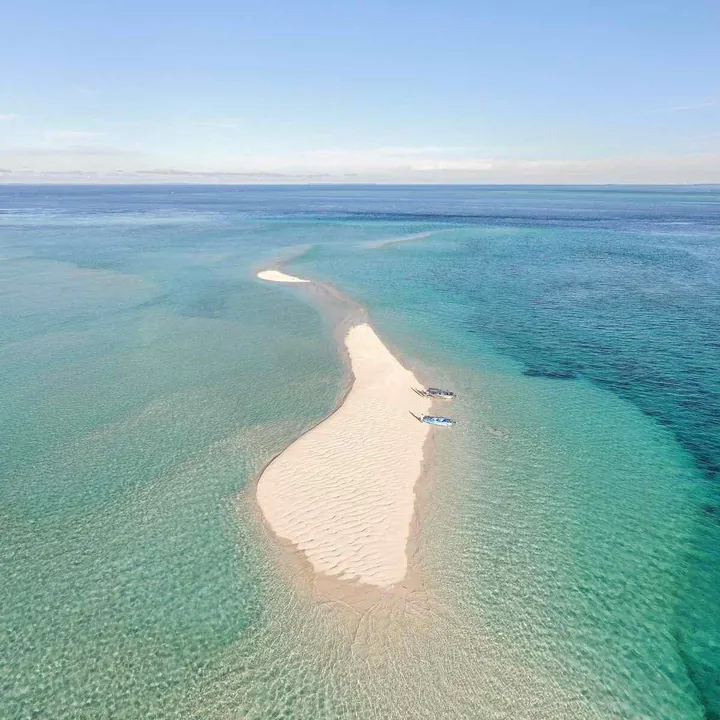
That drop-off is the dividing line between snorkeling and diving. Snorkelers work the top few metres of water above the reef shelf; the named walls, channels and caves below are a different sport. If you dive as well as snorkel, plan the two around each other using the Derawan dive sites guide, and read the Maratua Island page for the island’s geography, beaches and access points.

Talisayan whale sharks and Labuan Cermin bookend the circuit on the mainland

Talisayan sits on the mainland coast of Berau, and its whale sharks appear around the bagan fishing platforms rather than on a reef. It is an early start — boats leave in the dark to be in position at first light, because that is when the sharks are around the platforms. There is no reef here and no coral to look at; you are in open, deep water beside an animal that can be longer than the boat. The rules are strict and non-negotiable: no touching, no riding, no blocking the animal’s path. The Talisayan whale shark tour page covers the timing and the conduct code in full.

Labuan Cermin, in Biduk-Biduk, is the opposite kind of swim. It is a lake, reached overland rather than by island boat, where a layer of fresh water sits on top of salt water and the boundary between them is visible from the surface. Visibility is the attraction, not marine life. Many travellers use it as the last stop before flying out of Kalimarau because it is on the mainland side. See the Labuan Cermin mirror lake guide for how it fits into a route.

The best snorkeling season in Derawan runs April to November

Indonesia Juara operates the Derawan circuit from April to November — an eight-month window chosen around sea conditions, not around wildlife. Outside that window the crossings between islands get rougher and the open-water stops like Manta Point and Talisayan become unreliable, which is the real constraint on a snorkeling trip. Inside the window, the wildlife you are most likely to be asking about is present rather than seasonal: turtles are resident around Derawan and Sangalaki, and the manta feeding grounds are a year-round feature of the water rather than a migration event.

PeriodStatusWhat it means for snorkeling
April to NovemberOperating seasonFull nine-spot circuit is realistic, including the open-water and mainland stops
December to MarchOutside the seasonRougher crossings; open-water stops unreliable — we do not sell the circuit in this window

Two things are worth planning around inside the season. Talisayan is a dawn activity, so it dictates the shape of one whole day. And Labuan Cermin sits on the mainland, so it belongs at the start or the end of your route rather than in the middle of the island days. Both are handled for you on a guided Derawan island hopping tour.

How many days do you need for the Derawan snorkeling spots?

Three days is the practical minimum and four days is the comfortable version. The archipelago’s spots are spread across separate islands and one mainland coast, and the transfers between them are the limiting factor, not the snorkeling itself. Trying to compress the circuit into two days means dropping either Talisayan or Labuan Cermin, and both are stops people regret missing.

Trip lengthWhat fits comfortablyWhat gets tight
3 days / 2 nightsDerawan house reef, Kakaban, Sangalaki and Manta Point, Maratua highlightsFitting in both the dawn whale shark run and the mainland lake
4 days / 3 nightsThe full nine-spot circuit including Talisayan at dawn and Labuan CerminVery little — this is the version we recommend

How much does a guided Derawan snorkeling trip cost?

Indonesia Juara runs the archipelago as a private trip in 3D2N and 4D3N formats, with a minimum of two participants, and the per-person price falls as the group grows. Rates below are the current per-person figures in USD for the two service tiers — standard and premium — and they are indicative starting points, not fixed prices: the final quote depends on your exact group size, the tier you choose, your dates and the accommodation available for them.

Group sizeStandard (per person)Premium (per person)
2 peoplefrom USD 580from USD 672
3 peoplefrom USD 442from USD 506
4 peoplefrom USD 391from USD 437
5 peoplefrom USD 331from USD 368
6 peoplefrom USD 359from USD 391
7 peoplefrom USD 340from USD 368
8 peoplefrom USD 322from USD 345
9 peoplefrom USD 281from USD 304
10 peoplefrom USD 285from USD 304

Being straight about the boundaries: the trip is quoted from the meeting point at Kalimarau Airport (BEJ) in Berau, so your flights to and from Berau are not included, and neither is anything personal you spend on the islands. Because every quote is assembled per group, we confirm the exact inclusion and exclusion list in writing before you pay anything — ask for the current version at sales@indonesiajuara.asia. If you want the itinerary built specifically around snorkeling rather than diving, start from the Derawan snorkelling tour page, or compare formats on the Derawan trip page.

How to reach the Derawan snorkeling spots

Every trip starts at Kalimarau Airport (BEJ) in Berau, East Kalimantan, which is the meeting point for the private circuit. From Kalimarau the route continues overland to the coast and then by sea to Derawan Island, with the island-to-island legs handled by boat from there. Most international travellers connect domestically to reach Berau rather than flying in directly, so build a buffer into your arrival day — missing the boat window costs you a snorkeling stop, not just an afternoon.

The two practical routings are covered in detail on the how to get to the Derawan Islands guide, with the Berau option broken down step by step on the Derawan via Berau (Kalimarau) page. If you are combining Derawan with a wider Indonesia route, the Derawan Island tour page shows how the archipelago slots into a longer itinerary.

Where to stay between snorkeling days

Where you sleep decides how much dawn and dusk snorkeling you actually get. Accommodation used on the private circuit includes Reza Derawan Resort, Alfit VIP Borneo Cottage, Sienna Resort, Maratua Paradise Resort, Arasatu Villa, Pratasaba Resort and Seheku Paradise, and which of them you get depends on your tier, your dates and availability — the islands have a finite number of rooms and the season is only eight months long, so early dates matter more here than in most Indonesian destinations.

Staying on Derawan Island itself gives you the turtle shallows outside your door; staying on Maratua puts you closer to the drop-off reefs and the cave pool. The trade-offs are laid out on the Derawan Islands resort guide, with a dedicated page for Maratua Paradise Resort if you already know you want the Maratua side.

What to bring, and how to snorkel the archipelago responsibly

Bring your own mask if you own one — a mask that fits your face is the single biggest difference between a good day and a frustrating one, and rental sizing on small islands is limited. Add a rash guard or long-sleeve top instead of relying on sunscreen, because reef-safe or not, sunscreen washing off dozens of swimmers is a real load on an enclosed system like the Kakaban lake. Dry bags, a cheap pair of reef shoes for jetties and rocky entries, and any medication you need are the other items people wish they had packed.

The conduct rules across the archipelago are simple and enforced: do not stand on coral, do not chase or corner turtles and mantas, do not touch or lift jellyfish, and keep fins out of the Kakaban lake entirely. These animals are the entire economy of these islands. A snorkeler who keeps a respectful distance sees more anyway, because the animals stop reacting to you and go back to feeding.

Frequently Asked Questions

What are the best snorkeling spots in Derawan?

The Derawan circuit has nine signature snorkeling spots: the Derawan house reef, Kakaban jellyfish lake, Laguna Kehe Daing, Sangalaki, Manta Point, Goa Halo Tabung on Maratua, the Pasir Gusung Sanggalau sandbar, Talisayan and Labuan Cermin. They are deliberately different from one another — a turtle shallows, a landlocked jellyfish lake, a manta feeding ground, a cave pool, a tidal sandbar, a whale shark site and a two-layer freshwater lake — which is why a full circuit takes three to four days rather than one.

Can beginners snorkel in Derawan?

Yes — the shallows around Derawan Island are waist-to-chest deep in places and suit complete beginners, children and nervous swimmers. Start there on your first afternoon to get comfortable with your mask before the boat days. The sheltered stops, Laguna Kehe Daing and Goa Halo Tabung, are also calm. The two that demand confidence are Manta Point, which is open water with current, and Talisayan, which is deep water beside a very large animal; you can skip either one without losing the trip.

Do you need to scuba dive to see manta rays in Derawan?

No — mantas around Sangalaki feed near the surface, so snorkelers see them without any certification. That is unusual and it is one of the strongest arguments for Derawan over destinations where the big animals sit at depth. Divers get longer encounters and the wall and channel sites that snorkelers cannot reach, but for a manta sighting a mask and fins are enough. Keep your distance, never touch or chase, and let the animal set the direction.

Is the Kakaban jellyfish lake safe to swim in?

Yes — the jellyfish in Kakaban’s landlocked lake have effectively lost their sting, which is exactly why swimming among them is the archipelago’s signature experience. The risk runs the other way: the animals are fragile and the lake is a closed system. Fins are banned because they injure jellyfish and stir up the lake bed, and you should rinse off sunscreen before entering. Never lift a jellyfish out of the water for a photograph.

When is the best time to snorkel in the Derawan Islands?

The Derawan snorkeling season runs April to November, an eight-month window set by sea conditions rather than wildlife. Inside it, the crossings between Derawan, Kakaban, Sangalaki and Maratua are workable and the exposed stops like Manta Point and Talisayan can be run reliably. From December to March the crossings get rough and the open-water stops become unpredictable, so the full circuit is not sold in that window. Turtles and mantas are present throughout the operating season.

How much does a Derawan snorkeling trip cost per person?

A private Derawan trip starts from USD 580 per person for two people on the standard tier and drops to around USD 281 per person at nine people, with premium tier rates running higher. The per-person cost falls as the group grows, so the same trip is dramatically cheaper for a family or a group of friends than for a couple. Flights to Kalimarau Airport in Berau are not included. Email sales@indonesiajuara.asia for a quote on your exact dates and group size.