Derawan Dive Sites

Derawan Dive Sites
Derawan Dive Sites — Derawan Archipelago, Berau, East Kalimantan

Updated: August 2026

The Derawan dive sites are a cluster of named reefs, walls, channels and caverns spread across four islands in the Berau regency of East Kalimantan — Derawan, Maratua, Kakaban and Sangalaki — with Big Fish Country, Turtle Traffic, the Blue Light Cave and Channel Maratua the four names divers travel here for. They are dived from a single logistical base: Indonesia Juara private departures of 3D2N and 4D3N that start at Kalimarau Airport (BEJ) in Berau, run April to November, and cover nine locations across the archipelago.

This page is part of the Derawan activities category and is written for certified divers deciding whether the archipelago is worth the flights. If you are not certified, the same water is covered from the surface on the Derawan snorkeling spots page.

The Derawan dive sites sit on four islands, not one

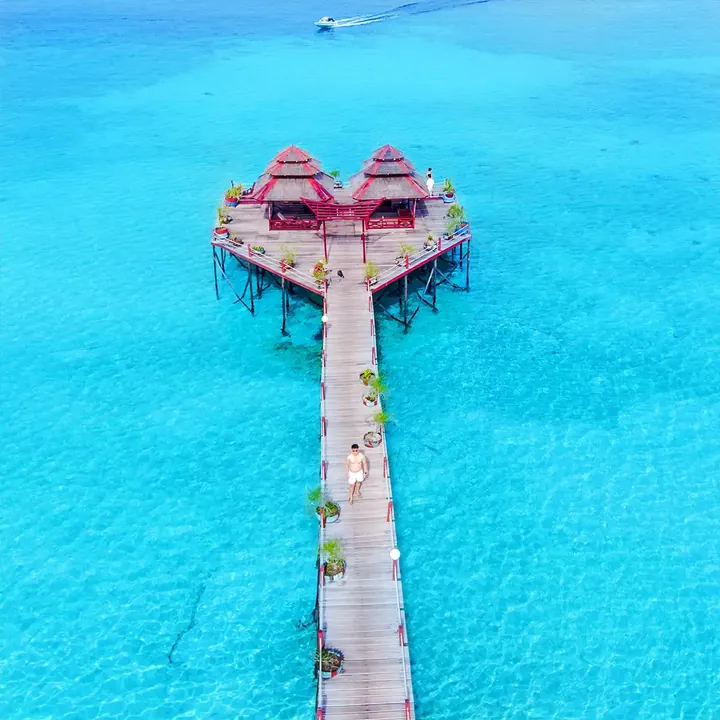
Derawan Island itself is the accommodation and logistics hub with easy house-reef diving. The signature sites are 45 minutes to 2 hours away by speedboat, on Sangalaki, Kakaban and Maratua. Planning a diving trip here means planning boat movements first and dive profiles second.

Dive siteIslandType of diveWhat it is known forSuits
Big Fish CountryMaratuaCurrent / driftSchooling barracuda and jack, reef sharks in the blueAdvanced, current experience
Turtle TrafficMaratuaWall and reefGreen turtles resting and passing in numbersAll certified levels
Blue Light CaveKakabanCavernNatural blue window of daylight inside the rockAdvanced, calm-water skills
Channel MaratuaMaratuaTidal driftWater moving in and out of the atoll lagoonAdvanced, tide-dependent
Manta PointSangalakiShallow reefReef manta rays feeding and circlingAll levels, also snorkellers
Derawan house reefDerawanReefTurtles, macro life, easy shore accessBeginners and refreshers

Most recreational diving in the Derawan Islands happens between 5 and 30 metres, inside standard no-decompression limits, with the usual 5-metre safety stop for 3 minutes. Open Water divers work to 18 metres, Advanced divers to 30 metres, and the absolute recreational ceiling is 40 metres. Exact profiles for each site are set by your guide on the day, based on tide, visibility and the certification mix in the boat.

Big Fish Country is a current dive before it is a big-fish dive

Big Fish Country, off Maratua Island, is the site that gave the archipelago its reputation among Asian and European divers. The draw is schooling pelagic life — barracuda and jacks massing over the reef edge with reef sharks patrolling the drop-off — but the reason it is rated for experienced divers is water movement, not depth.

Divers hold position on the reef, watch the school from below, and let the current do the work. If you have fewer than 20 logged dives or no drift experience, say so before the trip is planned: the guide can build a warm-up dive on the Derawan house reef into day one and put Big Fish Country on day two. Reef hooks, a surface marker buoy and a whistle are standard equipment for this kind of diving anywhere in Indonesia.

Turtle Traffic is the site that lives up to its name most reliably

Turtle Traffic is the Maratua wall dive where green sea turtles are seen resting on ledges and cruising the reef on a majority of dives. The Derawan Archipelago is one of Indonesia’s most significant green turtle habitats, and this is where that fact becomes visible underwater rather than statistical.

It is the friendliest of the four headline sites: a wall, a manageable profile, and animals that are not disturbed by respectful divers. The rule is the same as on every reputable operation — no touching, no riding, no blocking a turtle’s path to the surface, since a green turtle is an air-breathing animal that must be able to ascend. The nesting side of the same story is covered on the green turtle nesting Derawan page.

The Blue Light Cave is a cavern dive with a daylight window

The Blue Light Cave at Kakaban is a rock cavern where daylight enters through an opening and turns the interior water an intense blue. It is dived inside recreational limits and within sight of the entrance — it is a cavern, not a technical cave penetration, and it should never be treated as one.

Torches, a briefed buddy team and good buoyancy are the entry requirements, because a fin kick into silt ruins the visibility for everyone behind you. Divers with fewer than 30 logged dives are often better served by doing the outside reef at Kakaban Island instead and saving the cavern for a return trip.

Channel Maratua is dived by the tide table, not by the clock

Channel Maratua is the tidal passage where water floods into and drains out of the Maratua atoll lagoon, and it is the single most schedule-sensitive dive in the archipelago. The tide decides the direction, the speed and whether the dive happens at all on a given morning.

When it runs, it is a fast drift with the boat following your bubbles. When the tide is wrong, a good guide moves the group to Turtle Traffic or a sheltered reef rather than forcing it, which is why a fixed hour-by-hour dive schedule published weeks in advance is a warning sign rather than a service. Build at least one buffer day into your Derawan trip if this site is the reason you are travelling.

Sangalaki and Manta Point are the manta dives, and snorkellers get them too

Reef manta rays with wingspans commonly over 3 metres feed in the shallow water off Sangalaki Island and at Manta Point, both of which appear on the standard Indonesia Juara island itinerary. Because the mantas feed near the surface, this is one of the few world-class encounters where a snorkeller and a diver see roughly the same animal at roughly the same distance.

Sighting odds track plankton and tide rather than the calendar month, so nobody honest will promise you a manta on a specific date. Behaviour matters more than luck: stay low, stay still, never swim at a manta or block its path, and let it come to you. Full detail sits on the manta ray diving Derawan page.

Kakaban’s jellyfish lake is snorkelling only, and that is deliberate

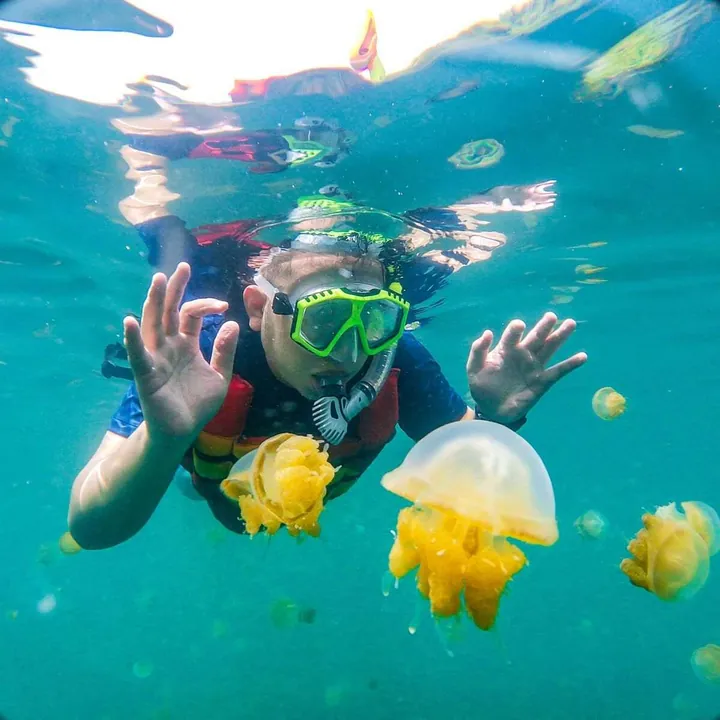
The stingless jellyfish lake on Kakaban is a snorkelling site, not a dive site. Scuba equipment is kept out of the lake because bubbles, fins and tank valves damage an enclosed population of jellyfish that exists in only a handful of places on the planet; sunscreen and rough handling do the same.

Divers visiting Kakaban dive the ocean reefs and cavern on the outside of the island, then walk in over the boardwalk and snorkel the lake as a separate, gear-light activity. It is usually the photograph people bring home.

How to reach the Derawan dive sites

Every Indonesia Juara departure begins at Kalimarau Airport (BEJ) in Berau, East Kalimantan, which is reached on domestic flights via Balikpapan or Jakarta. From the airport it is a road transfer to the coast, then a speedboat. Boat times below are approximate and depend on sea state, boat and the day’s itinerary.

LegModeApproximate time
Jakarta or Balikpapan to Kalimarau Airport (BEJ), BerauDomestic flightSchedule-dependent, same-day connection
Berau (Tanjung Redeb) to the coastal jettyRoadAround 2 to 3 hours
Jetty to Derawan IslandSpeedboatAround 30 minutes
Derawan to SangalakiSpeedboatAround 45 to 60 minutes
Derawan to KakabanSpeedboatAround 1 to 1.5 hours
Derawan to MaratuaSpeedboatAround 1.5 to 2 hours

The two realistic entry routes into the archipelago are compared on the how to get to Derawan Islands page, with the standard option detailed on Derawan via Berau. Divers arriving with their own regulators and computers should plan flights around the no-fly interval after their last dive, not the other way round.

The diving season runs April to November

Indonesia Juara operates Derawan departures from April to November, which is the practical diving window for the archipelago. Outside that period, sea conditions and boat movements between islands become the limiting factor, and a trip built around Channel Maratua or Big Fish Country stops being dependable.

Inside the season, conditions still vary week to week. Visibility, current strength and plankton — the same plankton the mantas are feeding on — move together, so the clearest water and the busiest manta days are not always the same days. If manta encounters matter more than photographic visibility, say so when the itinerary is being planned.

How many days you need for the Derawan dive sites

The minimum sensible commitment is the 3D2N private trip; 4D3N is the version that lets you reach Maratua without rushing. A 3D2N schedule realistically covers Derawan, Sangalaki and Kakaban. Adding Maratua — and with it Big Fish Country, Turtle Traffic and Channel Maratua — is what the extra day and night buys you.

If you want to dive Maratua properly rather than visit it, sleeping on Maratua is the better structure; options are set out on the Derawan islands resort page, with dedicated pages for the Derawan dive resort and Maratua Paradise Resort. Divers who want to cut boat transfers out entirely should look at the Derawan liveaboard option instead.

What a private Derawan trip costs per person

Indonesia Juara publishes the Private Trip Derawan 3D2N / 4D3N in two service tiers, standard and premium, with the per-person rate falling as the group grows. The minimum group size is 2 travellers. Rates below are from USD per person and depend on both group size and tier.

Group sizeStandard (from USD per person)Premium (from USD per person)
2 peoplefrom USD 580from USD 672
3 peoplefrom USD 442from USD 506
4 peoplefrom USD 391from USD 437
5 peoplefrom USD 331from USD 368
6 peoplefrom USD 359from USD 391
7 peoplefrom USD 340from USD 368
8 peoplefrom USD 322from USD 345
9 peoplefrom USD 281from USD 304
10 peoplefrom USD 285from USD 304

Two honest notes on that table. First, the per-person rate does not fall in a perfectly straight line — a group of 5 is cheaper per head than a group of 6, because boat and accommodation blocks change shape at certain group sizes. Second, these are private trip rates, not a scuba price list. Confirm in writing what your specific departure includes and excludes — tanks, weights, dive guide ratios, equipment rental, certification checks and any park or entry fees — before you pay a deposit. The full package structure is on the Derawan diving package page, and the multi-island version on the Derawan island hopping tour page.

What to settle before you book a diving trip here

Bring your certification card and logbook, declare any medical condition that affects diving, and be straight about your real experience level — the guide builds the site order around the least experienced person in the boat, and Channel Maratua is not the place to discover that. Dive insurance that covers recreational scuba is your own responsibility, and the nearest recompression facilities are not on the islands.

Indonesia Juara, part of Juara Holding Group since 2015, plans these departures privately rather than on fixed group dates. Send your certification level, logged dive count, preferred travel month and group size to sales@indonesiajuara.asia and ask for the current written inclusions before committing. If you are combining the archipelago with the whale shark morning at Talisayan whale shark tour or the freshwater layer at Labuan Cermin, mention it in the first email — those two additions change the boat schedule, not just the itinerary text.

Frequently Asked Questions

What are the best dive sites in Derawan?

The four most-requested Derawan dive sites are Big Fish Country, Turtle Traffic and Channel Maratua on Maratua, plus the Blue Light Cave at Kakaban. Manta Point off Sangalaki is added for manta rays, and the Derawan house reef is used for check dives and refreshers. Together they cover current diving, wall diving, cavern diving and shallow wildlife encounters within one archipelago of nine visited locations.

Do I need an advanced certification to dive the Derawan Islands?

Open Water divers can dive the Derawan house reef, Turtle Traffic and Manta Point, but Big Fish Country, Channel Maratua and the Blue Light Cave are planned for Advanced-level divers with current and buoyancy experience. Open Water certification works to 18 metres and Advanced to 30 metres, which covers almost all diving here. Declare your logged dive count honestly, because the guide sequences sites around the least experienced diver aboard.

When is the best time to dive Derawan?

Derawan departures run April to November, and that window is the practical diving season for the archipelago. Inside it, conditions shift week to week rather than month to month: plankton that boosts manta activity at Sangalaki is the same plankton that softens visibility. There is no single guaranteed best month, so choose by priority — photographic clarity or wildlife density — and let the operator match the dates.

How deep are the Derawan dive sites?

Most diving in the Derawan Islands is done between 5 and 30 metres, inside recreational no-decompression limits with a 5-metre safety stop for 3 minutes. Walls at Maratua drop well past recreational depth, so divers work the upper reef rather than the full drop. Final depth and profile for each site are decided by the dive guide on the day, based on tide, visibility and the certification mix in the group.

Can you scuba dive in the Kakaban jellyfish lake?

No — the stingless jellyfish lake on Kakaban is a snorkelling site and scuba equipment is kept out of it. Bubbles, fins and tanks damage an enclosed jellyfish population found in very few places worldwide, so the lake is entered gear-light, without sunscreen and without handling the animals. Divers visiting Kakaban dive the ocean reefs and cavern outside the island, then snorkel the lake separately on the same stop.

How much does a Derawan diving trip cost?

The Private Trip Derawan 3D2N / 4D3N starts from USD 281 per person for the standard tier at the largest group size, rising to from USD 580 per person for two travellers, with premium tiers priced above each. The rate depends on group size and service tier, and the minimum group is 2 people. Scuba-specific items are confirmed per departure — request the written inclusions from sales@indonesiajuara.asia before paying a deposit.