Updated: August 2026
Kakaban Island is an uninhabited island in the Derawan Archipelago, Berau Regency, East Kalimantan, and it holds a landlocked brackish lake where stingless jellyfish can be snorkelled — one of only a small number of such lakes anywhere on Earth. It sits roughly one hour by speedboat from Derawan Island and about 30 minutes from Maratua, which is why almost every itinerary in the archipelago pairs the three islands on the same route.
This guide covers what Kakaban actually is, how you reach it, what the jellyfish lake looks like in the water, the rules that protect it, the months worth travelling for, and how long to give it. Indonesia Juara, part of Juara Holding Group since 2015, runs private Derawan trips that include Kakaban among nine named stops.
Kakaban Island is a raised atoll with a two-million-year-old lake trapped inside it
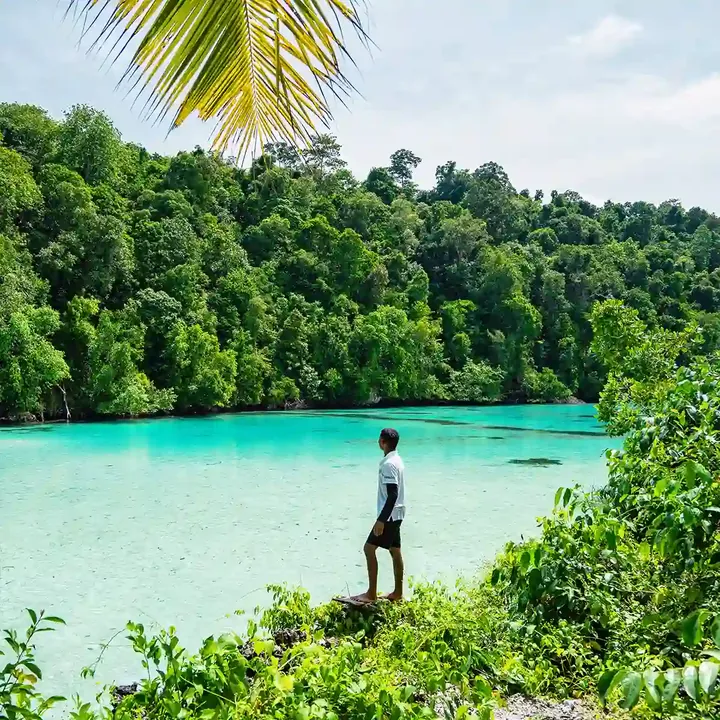
Kakaban is not a beach island. It is a ring of uplifted coral rock covering roughly 774 hectares, and geological uplift over roughly two million years lifted an ancient atoll lagoon clear of the sea, sealing about 5 square kilometres of water inside the rim. That trapped water is Kakaban Lake — brackish rather than fresh or fully marine, fed by rainfall and by seepage through porous coral, and cut off from the open ocean long enough for the species inside it to evolve separately from their relatives on the reef outside.
The island has no village, no road and no permanent population. Everything a visitor does here happens between the boat mooring, a short wooden boardwalk over the coral rim, and the lake itself. The Derawan Islands, Kakaban included, have been on Indonesia’s UNESCO World Heritage tentative list since 2005, and access to the lake is managed by local authorities rather than left open, so the current entry rules should be confirmed at the time you book rather than assumed from an older article.
| Feature | Detail |
|---|---|
| Location | Berau Regency, East Kalimantan, Derawan Archipelago |
| Island area | Roughly 774 hectares of raised coral |
| Lake area | Roughly 5 square kilometres, landlocked and brackish |
| Population | Uninhabited — no village, no accommodation |
| Signature experience | Snorkelling with stingless jellyfish |
| From Derawan Island | About 1 hour by speedboat |
| From Maratua | About 30 minutes by speedboat |
| Season we operate | April to November |
The jellyfish lake at Kakaban is one of a handful of stingless jellyfish lakes in the world
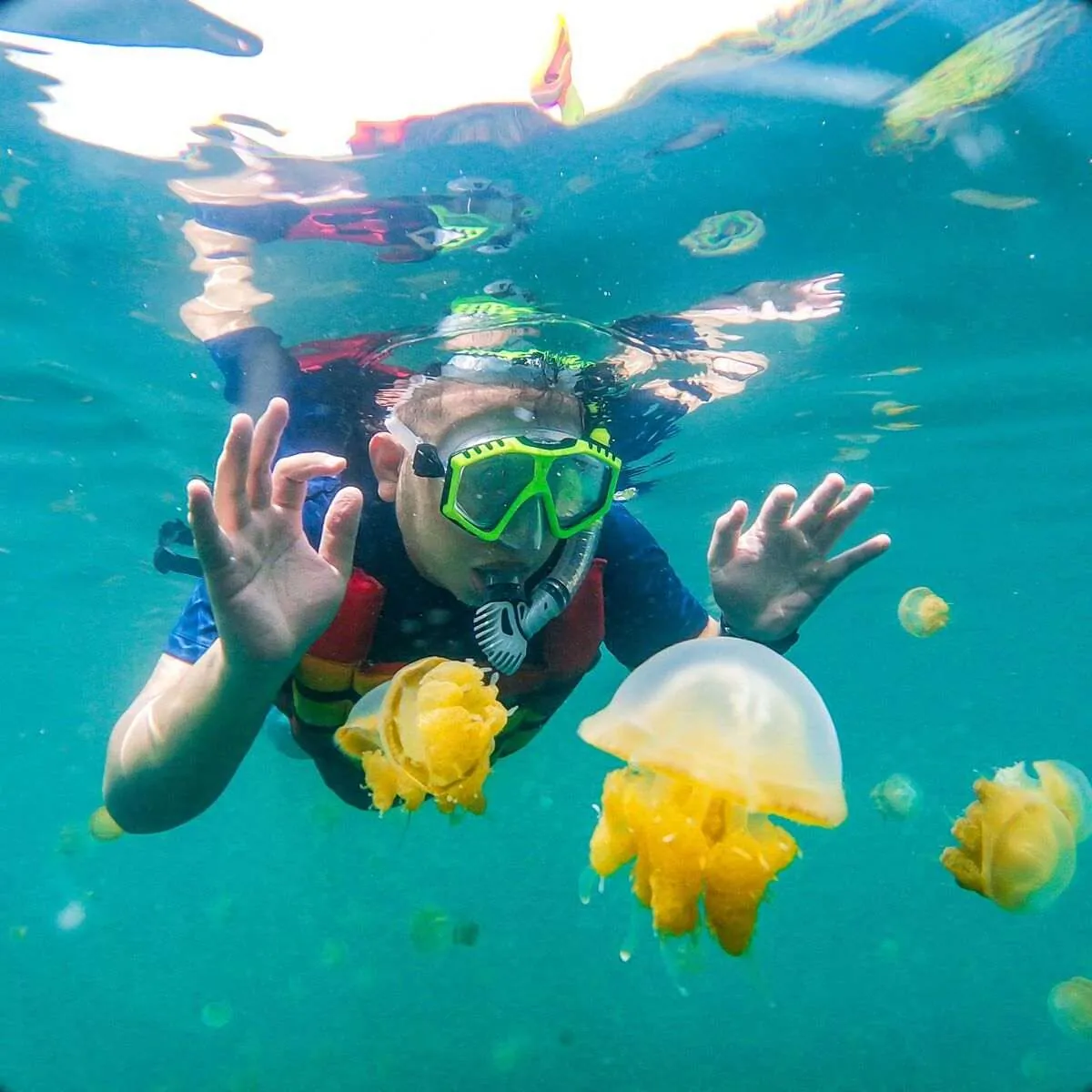
Kakaban’s jellyfish lake is famous for one reason: the jellyfish in it do not sting you meaningfully. With no significant predators inside a sealed lake, the stinging defence that jellyfish rely on in the open sea stopped being useful, and over generations it weakened to the point where a swimmer feels nothing more than the soft brush of a bell against skin. The nematocysts are not gone — they are simply too weak to penetrate human skin, which is the honest version of the word “stingless” that gets used on every brochure.
Four jellyfish species are consistently recorded in the lake, and on a good swim you will see at least three of them within the first ten minutes.
| Species | Common name | What you notice in the water |
|---|---|---|
| Mastigias papua | Golden or spotted jellyfish | The most numerous — pale gold bells drifting in loose clouds near the surface |
| Aurelia aurita | Moon jellyfish | Flat, translucent, with four visible rings; slower and lower in the water |
| Cassiopea ornata | Upside-down jellyfish | Rests bell-down on the lake bed with tentacles pointing up, easy to miss |
| Tripedalia cystophora | Small box jellyfish | Tiny, only a few millimetres across, usually spotted around the mangrove edges |
The lake is shallow where visitors use it and the jellyfish concentrate in the top three to five metres, so the entire experience is a surface one. Visibility is lower than on the reef outside — this is a closed, tannin-tinged, mangrove-fringed body of water, not a coral bay — and the light is best in the middle of the day when the sun is high enough to come straight down through the surface. Anyone expecting reef-grade clarity will be disappointed; anyone who understands they are swimming inside a two-million-year-old biological experiment will not be.
How to get to Kakaban Island from Berau, Derawan or Maratua
Kakaban has no airstrip and no scheduled public boat, so every visit is a day trip by chartered or group speedboat from another island in the archipelago. Our private trips meet at Kalimarau Airport (BEJ) in Berau, East Kalimantan, and the chain from there is fixed.
| Leg | Mode | Approximate time |
|---|---|---|
| Jakarta, Bali or Balikpapan to Berau | Domestic flight to Kalimarau Airport (BEJ) | Varies by origin and connection |
| Kalimarau Airport to Tanjung Batu coast | Overland transfer | Roughly 2 to 3 hours |
| Tanjung Batu to Derawan Island | Speedboat | About 30 to 45 minutes |
| Derawan Island to Kakaban | Speedboat | About 1 hour |
| Maratua to Kakaban | Speedboat | About 30 minutes |
| Kakaban to Sangalaki | Speedboat | Under 30 minutes |
Because Kakaban, Sangalaki and Maratua sit within an hour of each other, no sensible itinerary treats Kakaban as a standalone destination. The standard shape is one boat day that takes in Kakaban’s lake, Sangalaki’s mantas and a Maratua stop, which is exactly how the Derawan island hopping tour is built. For the full arrival chain from your home airport, read how to get to the Derawan Islands, and for the specific gateway we use, Derawan via Berau.
What you actually do on Kakaban: the boardwalk, the lake and the outer reef
The visit has three distinct parts, and most travellers only plan for one of them.
The boardwalk. Boats moor at the island edge and you cross a short wooden boardwalk and steps that climb the raised coral rim before dropping down to a platform on the lake. It is a walk of only a few minutes, but the coral rock is sharp and often wet — reef shoes or sandals with grip matter more here than on any other stop in the archipelago.
The lake. You enter from the platform, gently, and swim out. The jellyfish are not evenly spread: they follow the light, so they gather on whichever side of the lake the sun is on, and a guide who knows the lake will send you in the right direction rather than letting you drift over empty water. An hour in the lake is plenty for most people. Snorkelling only — diving inside the lake is not permitted.
The outer reef. Kakaban’s seaward side is a steep wall that falls away sharply from the shallows, and it carries dive sites in its own right, including the cave dive known as Blue Light Cave and the barracuda schooling point on the island’s corner. Most recreational dives here work in the 5 to 30 metre range. If diving is the reason you are travelling, the wall outside Kakaban belongs on the same list as Maratua’s channel — see Derawan dive sites for the full site-by-site breakdown, or the Derawan diving package for a dive-led itinerary.
The rules at Kakaban exist because the lake is fragile, and they are enforced
Kakaban’s jellyfish population is sensitive to physical damage and to chemicals in the water, and the lake has no way to flush itself out. The following rules are standard at the site and are worth knowing before you arrive, because they change what you pack.
- No fins. Fin kicks slice jellyfish bells and stir sediment. Swim with your arms, slowly.
- No sunscreen, no insect repellent, no oils. Rinse them off before entering; in a closed lake they do not disperse.
- No jumping or diving in. Enter from the platform, feet first and gently.
- Do not lift jellyfish out of the water. Air trapped under the bell damages them, and the photograph is not worth it.
- No scuba diving inside the lake. Bubbles are harmful to the animals. Diving happens on the outer reef only.
- Local entrance and conservation fees apply. Ask for the current figure when you request dates rather than relying on a number published elsewhere.
The best time to visit Kakaban is April to November
Indonesia Juara operates Derawan trips from April to November, an eight-month window when the Sulawesi Sea is calmest. That season matters more for Kakaban than for most stops, because reaching the island means an open-water crossing of 30 to 60 minutes in a speedboat, and a rough sea does not simply make the ride uncomfortable — it can remove the stop from the day entirely. Inside the season, aim for a lake swim between roughly 10:00 and 14:00, when the sun is high enough to light the water column and the jellyfish rise toward the surface to feed on the light their symbiotic algae need.
The jellyfish are present year-round; there is no migration and no arrival month to wait for. What changes across the year is sea state on the crossing and light on the lake, not the animals themselves. This is the opposite of Sangalaki Island, where manta encounters vary with feeding conditions, and of Talisayan whale sharks, which are met at first light around fishing platforms on the mainland coast.
How long to spend at Kakaban and where it fits in an itinerary
Budget two to three hours on Kakaban: a few minutes on the boardwalk each way, around an hour in the lake, and time to dry off and re-board. Longer than that and you are simply repeating the same swim. The island cannot absorb a full day because there is nothing else on it — no beach club, no village, no restaurant.
That makes Kakaban a half-day component rather than a destination in its own right, and it is why the archipelago is sold as a 3D2N or 4D3N route rather than as single-island stays. A typical shape puts Kakaban’s lake and Sangalaki’s mantas in one boat day, Maratua’s wall and channel in another, and the mainland features — Labuan Cermin Mirror Lake and Talisayan — on the arrival and departure days when you are already on the road. The nine stops and how they connect are mapped across the Destinations category.
There is no accommodation on Kakaban — you sleep on Derawan or Maratua
Nobody stays overnight on Kakaban. The island is uninhabited and has no lodging of any kind, so every visit is launched from a bed somewhere else. Our trips use properties on Derawan Island, on Maratua and on the Berau side, including Reza Derawan Resort, Alfit VIP Borneo Cottage, Sienna Resort, Maratua Paradise Resort, Arasatu Villa, Pratasaba Resort and Seheku Paradise, with the exact property depending on the tier and the dates.
The practical choice is between basing on Derawan Island, which puts you an hour from Kakaban but close to the archipelago’s services and its turtle-grazed house reef, and basing on Maratua Island, which halves the run to Kakaban and puts you on the atoll rim for diving. The trade-offs between the two are set out on where to stay in the Derawan Islands.
What a Derawan trip including Kakaban costs
Private Derawan trips that include Kakaban start from USD 281 per person, and the exact figure depends entirely on your group size and on whether you take the standard or premium tier. Per-person cost falls as the group grows because the boat, the guide and the transfers are shared across more people. The minimum booking is two travellers.
| Group size | Standard tier | Premium tier |
|---|---|---|
| 2 travellers | from USD 580 per person | from USD 672 per person |
| 3 travellers | from USD 442 per person | from USD 506 per person |
| 4 travellers | from USD 391 per person | from USD 437 per person |
| 5 travellers | from USD 331 per person | from USD 368 per person |
| 6 travellers | from USD 359 per person | from USD 391 per person |
| 7 travellers | from USD 340 per person | from USD 368 per person |
| 8 travellers | from USD 322 per person | from USD 345 per person |
| 9 travellers | from USD 281 per person | from USD 304 per person |
| 10 travellers | from USD 285 per person | from USD 304 per person |
These are starting rates for the private 3D2N / 4D3N trip meeting at Kalimarau Airport (BEJ), not fixed prices, and they move with dates, accommodation availability and the exact routing you choose. International and domestic flights to Berau are not part of the trip rate, and local entrance and conservation fees at sites such as Kakaban are confirmed separately. The full written inclusion and exclusion list for your dates comes with the quotation — the day-by-day routing sits on the Derawan island tour and Derawan trip pages. To request dates, write to sales@indonesiajuara.asia.
Kakaban compared with the other Derawan islands
Travellers regularly ask which island to prioritise if time is short. The honest answer is that they do different jobs, and Kakaban’s job is a swim you cannot replicate anywhere else in Indonesia.
| Island | Signature encounter | Diving or snorkelling | Overnight possible |
|---|---|---|---|
| Kakaban | Stingless jellyfish in a landlocked lake | Snorkelling in the lake, diving on the outer wall | No |
| Sangalaki | Reef manta rays and green turtle nesting | Both, mantas often shallow enough to snorkel | No |
| Maratua | Atoll walls and channel drift dives | Diving-led | Yes |
| Derawan | Green turtles on the house reef | Both, straight off the jetty | Yes |
If you have one boat day, spend it on Kakaban and Sangalaki together. If you have two, add Maratua’s channel. Snorkellers should read Derawan snorkelling spots next, and anyone considering covering the archipelago from a boat rather than a resort should look at the Derawan liveaboard option.
Frequently Asked Questions
Where is Kakaban Island?
Kakaban Island lies in the Derawan Archipelago in Berau Regency, East Kalimantan, Indonesia, about one hour by speedboat from Derawan Island and roughly 30 minutes from Maratua. It is an uninhabited raised atoll of around 774 hectares with a landlocked brackish lake of roughly 5 square kilometres at its centre. There is no airstrip and no scheduled public boat, so every visit is made by chartered or group speedboat from another island in the archipelago.
Do the jellyfish at Kakaban really not sting?
The jellyfish in Kakaban Lake have stinging cells that are far too weak to penetrate human skin, so swimmers feel nothing more than a soft brush against the body. With no meaningful predators inside a sealed lake, the stinging defence lost its purpose and weakened over generations. Four species are recorded in the lake — Mastigias papua, Aurelia aurita, Cassiopea ornata and the tiny Tripedalia cystophora — and the golden Mastigias are by far the most numerous.
Can you dive in the Kakaban jellyfish lake?
Scuba diving is not permitted inside Kakaban Lake — the lake is snorkelling only, because exhaust bubbles harm the jellyfish. Fins are also banned, since fin kicks damage the bells and stir sediment in water that has no way to flush itself clean. Diving at Kakaban happens on the outer reef instead, where the seaward wall drops away steeply and holds sites including Blue Light Cave, typically dived in the 5 to 30 metre range.
How long should I spend at Kakaban Island?
Two to three hours is the right amount of time on Kakaban, of which roughly an hour is spent in the lake itself. The island is uninhabited and has nothing beyond the mooring, the boardwalk over the coral rim and the lake, so a longer stay simply repeats the same swim. Most itineraries therefore combine Kakaban with Sangalaki in a single boat day rather than treating it as a full-day destination.
What is the best time of year to visit Kakaban?
April to November is the season for Kakaban, because that is when the Sulawesi Sea is calmest and the 30 to 60 minute open-water crossings between islands are most reliable. The jellyfish are present all year and do not migrate, so the season is about sea conditions rather than about the animals. Within a day, the best light in the lake falls roughly between 10:00 and 14:00, when the sun is high enough to reach down through the water.
Is there anywhere to stay on Kakaban Island?
There is no accommodation on Kakaban — the island is uninhabited and has no village, lodge or homestay. Visitors sleep on Derawan Island or Maratua and travel across for the day, with our trips using properties including Reza Derawan Resort, Sienna Resort, Maratua Paradise Resort, Arasatu Villa, Pratasaba Resort, Alfit VIP Borneo Cottage and Seheku Paradise. Basing on Maratua halves the boat run to Kakaban, while basing on Derawan keeps you closer to the archipelago’s services.