Green Turtle Nesting

Green Turtle Nesting
Green Turtle Nesting — Derawan Archipelago, Berau, East Kalimantan

Updated: August 2026

Green turtle nesting in Derawan happens every month of the year, with females coming ashore after dark to dig and lay on the sand beaches of Sangalaki, Derawan Island and the wider archipelago in Berau Regency, East Kalimantan. There is no single “nesting season” to book around — the practical question is when you can reach the islands comfortably, and that answer is April to November.

Indonesia Juara, part of Juara Holding Group since 2015, runs private trips through nine named stops in the archipelago, meeting at Kalimarau Airport (BEJ) in Berau. This page explains where green sea turtles in Derawan nest, what a nesting night actually looks like, when hatchlings emerge, the conduct rules on a nesting beach, and what a trip built around turtles costs.

Green turtles nest in Derawan all year, so timing is about sea conditions rather than turtles

The green turtle (Chelonia mydas) nests in the Derawan Archipelago continuously rather than in a short annual burst. Individual females do follow a rhythm — they nest several times within one season, then skip two to four years before returning — but because the population is large and the individuals are out of step with one another, some female is coming ashore somewhere in the archipelago on almost any given night.

That makes Derawan unusual. At most turtle destinations you plan a trip around a narrow nesting window and hope. Here the limiting factor is the crossing. The boat legs between the islands run across open water in the Sulawesi Sea, and from roughly December to March those crossings get rough and unreliable. Our private trips therefore operate from April to November, an eight-month window chosen for sea state, not for turtles.

QuestionAnswer
SpeciesGreen sea turtle (Chelonia mydas), listed as endangered on the IUCN Red List and protected under Indonesian law
Nesting monthsAll year round
Practical visiting windowApril to November, when crossings are calmest
Nesting time of dayAfter dark, typically between late evening and the small hours
Main nesting islandsSangalaki and Derawan Island
IncubationRoughly 45 to 70 days in the sand
Meeting point for tripsKalimarau Airport (BEJ), Berau, East Kalimantan

Where green sea turtles nest in the Derawan Archipelago

Two islands matter most for nesting, and a third matters most for seeing turtles in the water. Sangalaki is the principal nesting beach: a small, low, tree-covered island with no village and no resort, ringed by exactly the kind of soft sand above the high-tide line that a female needs. Derawan Island is the other nesting beach and the one you are most likely to sleep on, which means the sand outside your accommodation is working nesting habitat.

Maratua is different. The atoll’s value for turtles is underwater rather than on the beach — green turtles are seen on virtually every dive and snorkel session along the rim, resting under coral heads and rising to breathe. That is why the archipelago’s best-known dive site for the species is a drift called Turtle Traffic, covered in full on the Derawan dive sites page.

LocationRole for green turtlesAccessWhat visitors realistically see
SangalakiPrincipal nesting beach; no accommodation on the islandAround 45 minutes by speedboat from Derawan IslandTurtles in the water by day; nesting tracks on the sand
Derawan IslandNesting beach and main accommodation baseAround 30 minutes by speedboat from Tanjung BatuTurtles grazing under the jetties daily; nesting after dark
MaratuaFeeding and resting habitat on the atoll rimSpeedboat from Derawan; the only island with an airstripTurtles on almost every dive, including at Turtle Traffic
KakabanSurrounding reef, not a nesting focusUnder 30 minutes by speedboat from SangalakiTurtles on the outer reef; the lake itself holds jellyfish

If your priority is being close to nesting sand at night, base yourself on Derawan Island. If your priority is turtles underwater in numbers, weight the itinerary towards Maratua Island and the atoll rim. The full comparison of bases is on where to stay in the Derawan Islands.

What a green turtle nesting night actually looks like

A nesting emergence is slow, quiet and largely predictable, and it takes one to two hours from the moment the female leaves the water to the moment she returns to it. She is committed once she starts digging the egg chamber, which is why guides move visitors into position during that stage rather than earlier — a female disturbed while still selecting a site will usually abandon the attempt and go back to the sea.

StageWhat happensApproximate duration
EmergenceFemale hauls out of the surf and crawls above the high-tide line10 to 20 minutes
Site selectionShe tests the sand; may abandon and return to the sea if disturbedHighly variable
Body pit and egg chamberFront flippers clear a pit, rear flippers dig a flask-shaped chamber30 to 60 minutes
LayingAround 100 soft-shelled eggs deposited; she is least disturbable here10 to 20 minutes
Covering and camouflageChamber filled, sand thrown wide to disguise the nest20 to 40 minutes
Return to seaShe crawls back down the beach and swims off5 to 15 minutes

One female repeats this two to five times in a single nesting season, at intervals of roughly two weeks, before disappearing back to her feeding grounds for several years. Adult green turtles are herbivores that graze seagrass and algae, which is the same reason you see them so reliably in the shallows off Derawan Island by day — the food is there.

Hatchlings emerge roughly 45 to 70 days after the eggs are laid

Green turtle eggs incubate in the sand for about 45 to 70 days, so a nest laid on the night you watch will hatch long after you have flown home. The upside is that the same continuous nesting cycle means nests laid weeks before your arrival are hatching while you are there, and a hatchling emergence is the one turtle event that can happen at dawn as well as at night.

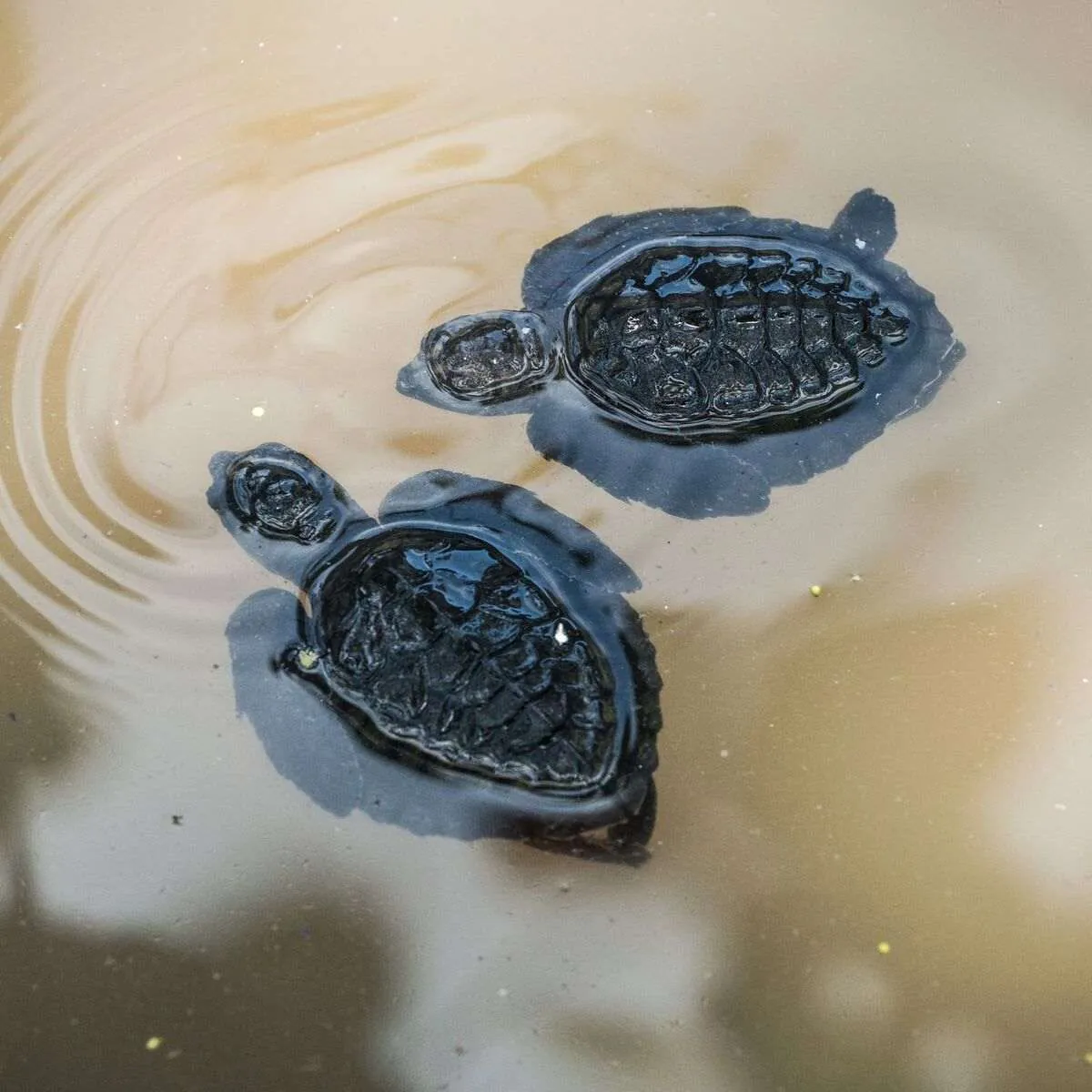
Hatchlings are around five centimetres long. They break out together, wait just under the surface until the sand cools, then surface as a group and run for the brightest horizon — which, on an undisturbed beach, is the sea reflecting the sky. This is why torches, phone screens and unshielded resort lighting near a nesting beach do real damage: they pull hatchlings inland, away from the water, and the ones that go the wrong way rarely make it.

Two other details are worth knowing. Sand temperature determines sex in sea turtles rather than genetics, with warmer nests producing more females and the pivot sitting around 29°C, which is why shading and nest placement matter to conservation work. And the survival odds are severe: the commonly cited estimate is that roughly one hatchling in a thousand reaches breeding age, so protecting the nest is only the first step in a decades-long process.

Seeing green turtles in the water is far easier than seeing them nest

Nesting is a night event, weather-dependent and never guaranteed. In-water encounters are close to a daily certainty. Green turtles graze under the jetties off Derawan Island in water shallow enough that you can watch them from the pier without getting wet, and any snorkelling session on the house reef will normally put you within a few metres of one.

For divers, the archipelago is one of the more dependable turtle destinations in Indonesia. Turtles rest under overhangs on the Maratua wall, cruise the shallows at Sangalaki, and appear in numbers at Turtle Traffic. Full site detail is on Derawan dive sites, and non-divers will find the shallow-water shortlist on Derawan snorkelling spots. Turtles and rays also overlap: the manta feeding grounds covered under manta ray snorkelling sit off the same island as the archipelago’s main nesting beach, which is why Sangalaki Island tends to be the single most requested stop of the nine.

The rules on a green turtle nesting beach

Green turtles are a protected species in Indonesia, and the beaches they use are treated accordingly. Our guides enforce the following, and they are not negotiable — a nesting beach that gets managed badly stops producing turtles within a generation.

  • No white light. No torches, no phone screens, no flash photography on the beach at night. Guides use dim red light only, and only when necessary.
  • Keep behind and low. Approach from behind the female, never in front of her head, and stay low so you do not break her horizon.
  • Do not touch. No touching, riding or handling turtles at any age, in the water or on the sand. The same applies to manta rays.
  • Wait for the laying stage. Nobody moves close until the female is laying. Before that she abandons easily.
  • Leave the sand alone. No digging, no sitting on nest mounds, no vehicles or fires on nesting beaches.
  • Do not move hatchlings. Let them crawl. That crawl is how they orient themselves for the rest of their lives.
  • Take your rubbish out. Plastic on a nesting beach is both an obstacle to hatchlings and a feeding hazard to adults offshore.

Turtle conservation in Derawan is a working problem, not a finished story

It is worth being straightforward about this. The Derawan Archipelago holds one of Indonesia’s significant green turtle populations, and that population exists alongside fishing communities, growing visitor numbers and expanding coastal development. Egg collection, accidental capture in fishing gear, marine plastic and artificial light near beaches are all pressures that have not gone away because a place became popular.

What visitors control is small but real: choosing operators that keep groups off nesting sand at the wrong moment, refusing turtle products of any kind, keeping lights off after dark near the beach, and carrying rubbish out. What investors and operators control is larger — beachfront lighting design, setback from the high-tide line, and waste handling are decided at the build stage, which is one of the themes covered on Derawan resort and eco-lodge investment.

We do not run a hatchery and we do not claim conservation credentials we have not earned. What we do is route trips so that turtle encounters happen in the water by day, keep beach conduct tight at night, and tell travellers plainly when something is not guaranteed.

How to plan a trip around green turtle nesting in Derawan

Every route into the archipelago starts at Kalimarau Airport (BEJ) in Berau, East Kalimantan, which is also where our private trips meet you. From there it is around two to two and a half hours by road to the Tanjung Batu coast, then about 30 minutes by speedboat to Derawan Island. Full routing detail, including flight connections, is on how to get to the Derawan Islands, with airport-specific notes on Derawan via Berau.

Three nights and two days is the shortest itinerary that works. Four days and three nights is the better choice for anyone who wants both a night on a nesting beach and a full day at Sangalaki and Kakaban, because it gives you a second attempt if the first night produces nothing. Minimum group size is two travellers.

Private Derawan trips start from USD 281 per person. The exact rate depends on your group size and on whether you book the standard or premium tier — the figures below are per person for the private 3D2N / 4D3N trip.

Group sizeStandard tierPremium tier
2 travellersfrom USD 580 per personfrom USD 672 per person
3 travellersfrom USD 442 per personfrom USD 506 per person
4 travellersfrom USD 391 per personfrom USD 437 per person
5 travellersfrom USD 331 per personfrom USD 368 per person
6 travellersfrom USD 359 per personfrom USD 391 per person
7 travellersfrom USD 340 per personfrom USD 368 per person
8 travellersfrom USD 322 per personfrom USD 345 per person
9 travellersfrom USD 281 per personfrom USD 304 per person
10 travellersfrom USD 285 per personfrom USD 304 per person

The per-person rate falls as the group grows because boat, fuel and guide are shared across more travellers. These are starting rates, not fixed prices — dates, tier and final routing all move the number, so we quote per request.

What the trip covers: the meet at Kalimarau Airport (BEJ), road transfer to the coast, the boat legs between islands, accommodation drawn from the properties we work with — Reza Derawan Resort, Alfit VIP Borneo Cottage, Sienna Resort, Maratua Paradise Resort, Arasatu Villa, Pratasaba Resort and Seheku Paradise — and guiding across the itinerary. The specific property is confirmed by tier and availability before you pay, not after.

What it does not cover: flights to and from Kalimarau, anything personal, and any diving-specific services, which are quoted separately on the Derawan diving package page. Because inclusions shift with itinerary length and tier, we send the definitive written list with your quote rather than asking you to infer it from a web page. To check dates, write to sales@indonesiajuara.asia.

Combine turtle nesting with the rest of the archipelago

Turtles are one reason to come and they pair naturally with the other eight stops. A four-day route can hold a nesting beach, a manta morning, a jellyfish lake and a whale shark dawn without feeling rushed.

Frequently Asked Questions

When is green turtle nesting season in Derawan?

Green turtles nest in the Derawan Archipelago all year round, so there is no closed season to plan around. The practical visiting window is April to November, which is when the open-water crossings between the islands are calmest and our private trips operate. Between roughly December and March the Sulawesi Sea gets rough and boat legs become weather-dependent, so a booked night on a nesting beach can be lost to swell even though the turtles themselves are still coming ashore.

Where can you see green turtles nesting in the Derawan Islands?

Sangalaki is the principal green turtle nesting beach in the archipelago, and Derawan Island is the second — which matters because Derawan Island is where most travellers sleep. Sangalaki has no village and no accommodation, so it is visited as a day stop by speedboat, around 45 minutes from Derawan Island. Maratua is better for in-water encounters than for nesting: turtles appear on virtually every dive along the atoll rim, including at the site known as Turtle Traffic.

How long does a green turtle take to lay her eggs?

A full nesting emergence takes one to two hours from the moment the female leaves the surf until she returns to it. Digging the body pit and egg chamber accounts for 30 to 60 minutes of that, the laying itself for 10 to 20 minutes, and covering and camouflaging the nest for another 20 to 40 minutes. She is most easily disturbed at the start, while selecting a site, and least disturbable once laying has begun, which is why guides hold visitors back until that stage.

How many eggs does a green turtle lay, and when do they hatch?

A green turtle clutch holds around 100 eggs, and they incubate in the sand for roughly 45 to 70 days before hatching. One female nests two to five times in a season at intervals of about two weeks, then skips two to four years before returning. Sand temperature determines the sex of the hatchlings rather than genetics, with the pivot around 29°C — warmer nests produce more females, which is why shading and nest placement are part of conservation work.

Can you see baby turtles hatching in Derawan?

Yes, hatchling emergences happen throughout the year in Derawan because nesting is continuous, but they cannot be scheduled. Hatchlings surface as a group once the sand cools, usually after dark or at first light, and run for the brightest horizon — which should be the sea. Nobody should carry, hold or redirect them: that first unaided crawl is how a hatchling orients itself. Torches, camera flash and phone screens pull them inland and are banned on nesting beaches for that reason.

Is it ethical to watch turtle nesting in Derawan?

Watching green turtle nesting is defensible when it is guided, unlit and kept behind the animal, and harmful when it is not. The rules that make the difference are simple: no white light, no flash, no touching, approach only once laying has begun, and never dig, sit on or drive across nesting sand. Green turtles are protected under Indonesian law and listed as endangered internationally, so operators that break these rules are both illegal and self-defeating.